Showing posts with label Paralympics 2012. Show all posts

Tuesday, September 11, 2012

Learning From Paralympics 2012

aNt's aNgle: Here is a letter that appeared in the Sunday Star recently. I totally agree with Clara that disability sport can teach a lot of things to the world. The recent Paralympics 2012 was a classic example of humanity at its best in the face of the real struggles we, as persons with disabilities have to face in life:

Sunday September 2, 2012

‘Superhuman’ athletes


I’M really happy that Anthony Thanasayan writes many articles about the disabled as these open our eyes to many things we take for granted.

I am currently based in London and followed the Olympics in July and last month. However, due to ignorance, I suppose, I was not keen on watching the Paralympics (Aug 29-Sept 9).
But now, with the exposure the media is giving it in London, I am really convinced that paralympians are indeed “superhumans”.

They are really inspiring and have made me, an able-bodied person, want to get up and start pushing my body to its limits.

The effort these people have put in, their pain and their feats are above and beyond anything I can imagine. They show us another side to their disability which, in some ways, is their strength.
I really hope Anthony will continue to write about them and their journey in his column (Wheel Power; Living, every Thursday).

The theme for the London Paralympics is “Inspiring A Generation” and I really do believe for the families, and especially children, of those involved, the games will give them hope and some sort of motivation.

As for the able-bodied, it should make us more aware of the athletes and their events.
Clara

PET+BLOGSPOT is the ONLINE BLOG of the Malaysian Animal-Assisted Therapy for the Disabled and Elderly Association or Petpositive. Our stories are CURRENT, ACCURATE and RELIABLE. We offer both local and foreign news on animals, disability and the elderly. PET+BLOGSPOT was first established in October 2007. Our hits since then are now 150,000 and ever increasing! PET+BLOGSPOT is updated daily. Kindly note that views expressed in PET+BLOGSPOT are not necessarily those of PETPOSITIVE. You may also visit our Webpage by browsing: www.petpositive.com.my You can also find us in Facebook under PETPOSITIVE EMPOWERMENT. Please sign up as a FOLLOWER of this Blog if you haven't done so already in order to show us your kind support for our work. Thank you!

Monday, September 10, 2012

Coldplay Leads Paralympics Closing


Paralympic Games: Closing ceremony led by Coldplay

Acrobats and dancers performed to live music from the band Coldplay and other artists in what was described as a festival of fire

London's 2012 Paralympics has ended with a fiery finale and official handover to 2016 host, Rio de Janeiro.

The show, described as a "festival of flame" honouring Britain's ancient traditions and festivals, brought 11 days of sport to a close.
UK band Coldplay led the show, which started at 20:30 BST, with a live set reflecting the four seasons.

The event ended what organisers say has been "the greatest Paralympic Games ever".
Unlike the other Games ceremonies, the 4,200 athletes were seated around the main arena, putting them at the heart of the action.
 
At the Olympic Stadium
If the Paralympics had to end then they did so in style, with a superb closing ceremony that had a bit of everything.

There were spectacular moments, dazzling fireworks, great live music and tributes to all the right people - the armed forces, the Games Maker volunteers and the athletes.

The speeches were made in the right tone and contained good and appropriate anecdotes and the tale of the four seasonss from autumn going to spring showed the continuing nature of life.

And that is what everyone has to face now with a Monday morning that won't contain tales of medals won and those possibly to come.

It is back to reality for most people and on to pastures new for others.

London 2012 will never be forgotten.

Declaring the 2012 Paralympics closed, International Paralympic Committee president, Sir Philip Craven, said: "These Games have changed us all forever."

China finished top of the Paralympic medals table, with 231 medals - 95 gold. Great Britain cemented third place behind Russia, with a tally of 120, including 34 golds.

As the ceremony drew to a close, Paralympians Ellie Simmonds and Jonnie Peacock helped to put out the Paralympic flame, which was shared out across the stadium symbolising "the eternal nature of the flame living among us all".

Each participating country will take home one of the 200 copper petals that made up the Paralympic cauldron.

In other developments on the final weekend of 2012:
  • Thousands of spectators cheered GB's David Weir to victory in the wheelchair marathon - his fourth 2012 gold medal.
  • Team-mate Shelly Woods took the silver in the women's race
  • On Sunday, Brazil's Tito Sena won the T46 marathon, and Alberto Suarez of Spain won gold in the T12 event, breaking his own world record with a time of 2:24:50
  • Channel 4 revealed more than four million people tuned in to watch South Africa's Oscar Pistorius win gold in the T44 400m on Saturday night
  • Organisers say some 2.7 million Paralympic tickets have been sold - beating targets by 200,000 and predicted sales by £10m
On Monday, 800 British stars of the Olympics and Paralympics will celebrate their success during a victory parade through the streets of London.
Mayor of London Boris Johnson said he hoped to see a social and cultural legacy from the Games.
'A few surprises' As Sunday's show began, a tribute was paid to the armed forces and military charity, Help for Heroes.

GB Paralympians David Weir and Sarah Storey, who both won four gold medals at the Games, carried the British flag into the stadium, as flagbearers representing 164 nations participating in the

Paralympics entered the arena.

And Captain Luke Sinnott, who lost both legs in an IED bomb blast while serving in Afghanistan, climbed the flagpole to raise the Union Jack.

Coldplay sang songs from their five albums, while dancers including the Candoco Dance Company - a contemporary group of 12 disabled and non-disabled dancers - performed with flames around the burning face of a "sun king".

Apart from Coldplay's live set, the sold-out finale featured performances from pop star Rihanna, rapper Jay-Z and a cast of around 1,200 performers on three circular stages - Summer, Winter and the Sundial.

"The idea is the coming together as one," said artistic director Kim Gavin behind the Festival of Flame.

"We are known as a nation for having the most festivals, it is something that we do - with 600 festivals a year.
 
"We pay tribute to all the human spirit and achievement through this wonderful sport of the last two weeks."
Kenya's Mary Nakhumicha ZakayoIrish and Irish runner Michael McKillop were presented with gold medals in recognition of them winning the Whang Youn Dai Achievement Award - for athletes who exemplify the best spirit of the Paralympic Games.

Flowers were also presented to honour the 70,000 Games Maker Olympic and Paralympic volunteers.
Some 120 child volunteers from east London took part in the spectacle, along with disabled aerial performers from Circus Scape and The British Paraorchestra.

After the Paralympic flag was passed to the Mayor of Rio de Janeiro, Eduardo Paes, performers from Rio - which will stage the games in 2016 - put on a colourful performance fusing hip-hop freestyle and samba, performed by disabled and non-disabled dancers.

Speaking to the 80,000-strong crowd, organising committee chairman Lord Coe said the UK would "never think of sport the same way and we will never think of disability the same way.
"The Paralympians have lifted the cloud of limitation."

He added: "Finally, there are some famous words you can find stamped on the bottom of a product. Words, that when you read them, you know mean high quality, mean skill, mean creativity.
'Superhuman' achievements
"We have stamped those words on the Olympic and Paralympic games of London 2012.
"London 2012. Made in Britain."

IPC president Sir Philip Craven said the Games had been "unique and without doubt, in my mind and those of the athletes - the greatest Paralympic Games ever".

Speaking before the start of the ceremony, Prime Minister David Cameron said: "I think it's been an absolute triumph from start to finish and I'm really proud of the country, not just that we've put on a great show, but we've had these great audiences".

Mr Cameron, whose disabled son Ivan died in 2009, added: "I think back to Ivan. As every parent, you think about all the things they can't do, but at the Paralympics they are superhuman, you see all the things they can do."

He also said it would give momentum to sports participation and the Paralympics had changed perceptions of disabled sport.

Are you attending the Paralympics closing ceremony? Will you watch the event on TV? What is the legacy? Send us your comments and experiences using the form below.

PET+BLOGSPOT is the ONLINE BLOG of the Malaysian Animal-Assisted Therapy for the Disabled and Elderly Association or Petpositive. Our stories are CURRENT, ACCURATE and RELIABLE. We offer both local and foreign news on animals, disability and the elderly. PET+BLOGSPOT was first established in October 2007. Our hits since then are now 150,000 and ever increasing! PET+BLOGSPOT is updated daily. Kindly note that views expressed in PET+BLOGSPOT are not necessarily those of PETPOSITIVE. You may also visit our Webpage by browsing: www.petpositive.com.my You can also find us in Facebook under PETPOSITIVE EMPOWERMENT. Please sign up as a FOLLOWER of this Blog if you haven't done so already in order to show us your kind support for our work. Thank you!

Sunday, September 09, 2012

Fitting Finale To Paralympics 2012


Oscar Pistorius
8 September 2012 Last updated at 21:23 GMT

Paralympics 2012: Oscar Pistorius powers to T44 400m gold


South African Oscar Pistorius provided a fitting finale to the Paralympics track and field competition with gold in the last event, the T44 400m.

The 25-year-old, promoted as the face of the Games, went into the final without an individual gold but won in a new Paralympic record of 46.68 seconds.

He finished almost four seconds ahead of Blake Leeper, with fellow American David Prince taking bronze.

Pistorius also won gold in the 4x400m relay and silver in the 200m.

Analysis

"I think it's how the athletics had to end. It was perfect having Oscar Pistorius as the last event. I am pleased for him as an athlete. You could tell he felt despondent about his performances in his other events, so after all the pressure on him, it's a huge amount of relief. It was never going to be easy to do the two events (200m and 400m) back to back. I was a bit disappointed with Alan Oliveira but it proves he can't run a 400m."

Defending champion Pistorius was expected to win the race easily, although at the 200m mark it appeared that Brazil's Alan Oliveira, who stunned the South African in the 200m, might just cause another Paralympics shock.

But Pistorius pulled away from his main rival coming into the final, with 20-year-old Oliveira tying up badly in the home straight and passed by the American pair.

"It is very, very special to me," Pistorius said. "It was the last event of my season, the last event of the London 2012 Paralympic Games (at the stadium). It was just so special.

"It was the 11th time I was able to come out on the track and I just wanted to give the crowd something they could appreciate and take home with them.

"I was very nervous before today's race. I was quite tired but the crowd really kept me going.
"For the first time I was actually thinking about something beside my race coming into the home straight.

"I could hear the crowd, which was very weird and so loud. I thought 'let's just finish off on a good note'."

There was no final flourish for Great Britain's athletes in front of a capacity 80,000 crowd.
Welsh world champion javelin thrower Nathan Stephens finished 12th after two throws and a poor third effort meant a premature end to the 24-year-old's participation in the F57/58 competition.
Jarrow sprinter Hazel Robson finished seventh in the T36 100m - the 33-year-old, who has cerebral palsy, won gold in the event in Sydney.

Britain have dropped from second to third in the overall medals table behind Russia, which now has 35 golds to GB's 33, with Ukraine just behind on 32 and Australia on 31 ahead of the final day of competition. China are way out in front with 95 golds.

Elsewhere in the Olympic Stadium, world records fell, including in the crowd-pleasing F46 high jump final. Poland's Maciej Lepiato shattered the previous best of 2.05m with a 2.12 clearance.
Meanwhile, South Africa's Fanie van der Merwe fell over the line to take the T37 100m title. He recorded the same time as China's Liang Yongbin - a world record of 11.51 - but was given gold following a photo finish.

The athletics competition finishes on Sunday with the marathons, with GB's David Weir attempting to win a fourth gold of the Games in the men's T54 event starting at 1130 BST.
PET+BLOGSPOT is the ONLINE BLOG of the Malaysian Animal-Assisted Therapy for the Disabled and Elderly Association or Petpositive. Our stories are CURRENT, ACCURATE and RELIABLE. We offer both local and foreign news on animals, disability and the elderly. PET+BLOGSPOT was first established in October 2007. Our hits since then are now 150,000 and ever increasing! PET+BLOGSPOT is updated daily. Kindly note that views expressed in PET+BLOGSPOT are not necessarily those of PETPOSITIVE. You may also visit our Webpage by browsing: www.petpositive.com.my You can also find us in Facebook under PETPOSITIVE EMPOWERMENT. Please sign up as a FOLLOWER of this Blog if you haven't done so already in order to show us your kind support for our work. Thank you!

Thursday, September 06, 2012

Paralympic Euphoria!


  SO, how has the non-stop action from the greatest show on Earth been treating you?   
 
If you haven’t already guessed, I’m referring, of course, to the 2012 13th Paralympic Games that kicked off in London last week on Wednesday.

More than a whopping 4,000 of the best athletes with disabilities from 164 countries have been taking part for the past nine days in one of the toughest yet competitions that draws to a close on September 9.

I’ve been trying to follow the sporting action as much as I can on BBC Online, TV and radio. As it turns out, it isn’t just the high octane events in the stadium alone that caught my attention in this year’s Paralympics.

Here are some of the unusual, inspiring and exceptional moments from my notebook that are worth to seriously think about:   

·       Paralympics v the Olympics: Whilst there has always been a debate about running the Paralympics simultaneously with the Olympics, for the first time I can see why having the handicapped games separately has its huge advantages. A re-ignition of the Games three weeks after the Olympics ended effectively brought back all the sparks, enthusiasm and euphoria of the Olympics with a special and more pronounced focus on disabled sportsmen and women. To me, this could not have quite achieved the same effect had the handicapped athletes shared the limelight with the Olympians. The opportunity allowed for a total immersion of disability sports and what it is all about. The BBC noted that the local and worldwide coverage and appetite for disabled sports – which had been dismally unequal for years – thanks to 2012, now bodes well for future Paralympics. Late last week it was reported that 2.4m of the 2.5m tickets had been sold. There is also a lesson here for our media in covering local disability sport. Disabled sports NGOs have always complained that various sports events for the handicapped are not covered by our media. But perhaps the NGOs too must take some blame for not putting enough effort to highlight such information to the press.   

·       Non athletes with disabilities not left out: As the BBC put it, the opening message was clear: “From the call for intellectual curiosity from Professor Steven Hawking, to the high wire arrival in the stadium of a double-amputee serviceman, topped off by the lighting of the cauldron by the winner of Britain's first Paralympic gold medal over 50 years ago - disabled people excel in many areas, and not just sport.” I thought that this was a brilliant point to put across. Life can be an equally tough – or perhaps even more - for people with disabilities who have to face daily struggles in a society that hasn’t taken their needs into account. The organisers certainly thought deeply about every possible subtlety in the ceremony.
·       Disabled people as pundits and commentators on radio and TV:  This was another marvellous move. Instead of always getting the perspectives from people who have no experience with disability, the “straight from the horses’ mouth” approach was much, much better and commendable. And what a refreshing change that brought about with a multitude of views!  Whilst disability activists in the UK were looking forward to Paralympic 2012 to change negative perceptions about them, they were equally concerned about the “darker side to disability in Britain.” Charities like Scope  pointed out that attitudes to people with disabilities have noticeably worsened in the past year over government plans to cut welfare benefits which often allies "disabled" to "benefit scrounger". Scope hopes the Paralympics could help reverse this trend. Disabled actor and stand-up comedian Liz Carr, however, is worried that the Paralympics could divide disabled people by turning them into super men and women instead of who they really are – and not within the paralympian ideal. Baroness Tanni Grey-Thompson, winner of 11 Paralympic gold medals for being one of the world's most successful wheelchair racers, likened the Games to fairy dust. “We sprinkle (it on) life as a disabled person; it shows a snapshot in time of some extraordinary people who train very hard, who are good at sport," she said. "It is great while it lasts, but probably not going to change the world, and certainly not on its own." Baroness Grey-Thompson would be the first to admit that while she can leave people far behind as she powers down the track, she still cannot get down an escalator to board an inaccessible tube train and needs the public's help to do what they regard as very ordinary things.
For continued coverage on the 2012 Paralympics go to: http://www.bbc.co.uk/sport/0/disability-sport/
The End

PET+BLOGSPOT is the ONLINE BLOG of the Malaysian Animal-Assisted Therapy for the Disabled and Elderly Association or Petpositive. Our stories are CURRENT, ACCURATE and RELIABLE. We offer both local and foreign news on animals, disability and the elderly. PET+BLOGSPOT was first established in October 2007. Our hits since then are now 150,000 and ever increasing! PET+BLOGSPOT is updated daily. Kindly note that views expressed in PET+BLOGSPOT are not necessarily those of PETPOSITIVE. You may also visit our Webpage by browsing: www.petpositive.com.my You can also find us in Facebook under PETPOSITIVE EMPOWERMENT. Please sign up as a FOLLOWER of this Blog if you haven't done so already in order to show us your kind support for our work. Thank you!

Wednesday, September 05, 2012

OK To Call Disabled Athletes Brave?


Paralympics 2012: Is it OK to call the athletes brave?


Paralympian Aled Davies

Before the Paralympic Games started, the media earnestly discussed the words that should and shouldn't be used. It can be a curious area.

One thing that tends to draw disabled people together is the subject of what people do and don't want to be called.

At the Paralympics stadiums and arenas, the commentators you hear on the public address system refer only to the technical terms, sounding a bit like playing a game of battleships: T54, C3, S6.
The first letter of this refers to the event - like T for track, C for cycling or S for swimming. The number refers to the level of impairment where usually the lower numbers are most disabled, and higher numbers least. I've yet to hear an official shouting something like "she's got spina bifida".
Earlier this year, the British Paralympic Association (BPA) put out a Paralympics language guide and media organisations covering the Games have had meetings and have drafted documents about it to make sure they get it right when reporting.
Reporting guidelines The British Paralympic Association has issued a guide on reporting the Paralympics. In it, they advise journalists to ensure that some words and phrases are totally avoided. In particular:
  • "suffers from"
  • "sufferer"
  • "victim of"
  • "normal"/ "abnormal"
The report notes that these terms are still commonly used when they should not be.
Mostly this is about Paralympic etiquette - apparently we shouldn't refer to someone as a "former Paralympian" for instance. If they've been a Paralympian they're always a Paralympian. But much of it is about respect for people and their achievements.

In the park on Saturday, I wandered around asking people what words they would use to describe the athletes. Jacqui and John Voyce, from Winchester, had brought their nine-year-old twins along.
Between them they agreed that the athletes were both brave and inspirational. John hesitated though.

"I don't want to say inspiring," he says. "I'm in the forces and a lot of the paralympic athletes are also ex-forces. They say they don't want to be referred to as inspiring because they are what they are and they're just doing it."

The sensitivity around these words is particularly interesting around Paralympics time.

This week we're seeing elite disabled athletes running, swimming, shooting arrows, playing tennis and more. They are certainly inspiring - as are all athletes, but decades of low expectations about disabled people means that they have often been classed as heroic just for going down the shop to buy a pint of milk.

In some circles, words that patronisingly elevate disabled people to a superhuman level they don't really deserve are seen as more damaging and life-limiting than good old-fashioned playground taunts.

Actor Jamie Beddard, who was lead artist in Breathe, a mixed ability performance on Weymouth beach which opened the Olympic venue in July, says: "Most epithets such as inspirational, brave, etc, are used as a means of separating us [the disabled] from them [the non-disabled] and have all kind of 'there but for the grace of God go I' notions."

Perhaps overly aware of the issues of language, while listening to BBC Radio 5 live, I heard a sports presenter refer to a swimmer as having had a "brave" performance.

Did he mean braver than average, brave to have got in the pool, or was there something about the swimmer's performance that really was wrenchingly physical and tough to achieve? I was left believing he meant the latter and wasn't being at all condescending.
Paralympics classifications
Paralympic athlete with running blades
  • Paralympic athletes compete in different classes according to type and/or severity of disability
  • Athletics: T and F designate track or field with number for type of disability, eg: F54 = wheelchair track athlete with full arm and hand function
  • Football: Five-a-side for athletes with visual impairment, seven for those with cerebral palsy
  • Swimming: 1-10 indicate physical disability, with lower numbers for severer disabilities
Quentin Hull is a sports commentator for ABC, Australia's official Paralympic broadcaster, doing his second Games.

"Those phrases that we're probably told to hold back on like inspirational, all those words just drip off your tongue during a paralympic Games because of the human achievement mixed in with the athletic achievement," he says.

"There's a bit more of a purity to the fact that the human race battles to succeed no matter what the cost because it's a bit more visible and easy for someone to fathom the effort put in when they see Oscar Pistorius with two prosthetic legs.

"If you see eight guys running in a race at the Olympics, all with two arms and two legs running fast, it's very hard to work out their achievement story because the timepiece only shows you the athletic achievement, it doesn't show the human achievement."

But interestingly the athletes don't necessarily know the language rules. After a match, one GB athlete said: "The crowd went mental."

With over 6,000 people cheering her on, you can perhaps appreciate why she reached for the word "mental", especially as it's so often used in a casual manner away from the arena of mania and schizophrenia.

But it's one of the disability words that I choose to avoid using in that way, like its linguistic friend "psycho". Life experiences tend to dictate your own personal dictionary.

On Sunday night, Channel 4's dressage commentary referred to Sophie Christiansen's "involuntary movements".
Sophie Christiansen A commentator referred to Sophie Christiansen's "involuntary movements"

How do we feel about commentary on cerebral palsy spasming? The British Paralympic Association would rather you didn't dwell on people's disability but, if it's visible on your TV screen and could be seen by the audience as potentially destroying those nice clean body lines or whatever it is that dressage experts might talk about, is it OK as a bit of analysis?

I'm not sure that debate has ever properly happened without a room full of fearful television executives nodding as they scribble notes and try hard to get their heads around it.

The fear factor is high and in my long experience of these things, can sometimes stop programmes going out or disabled contributors being used on air because some people just really badly don't want to get it wrong.
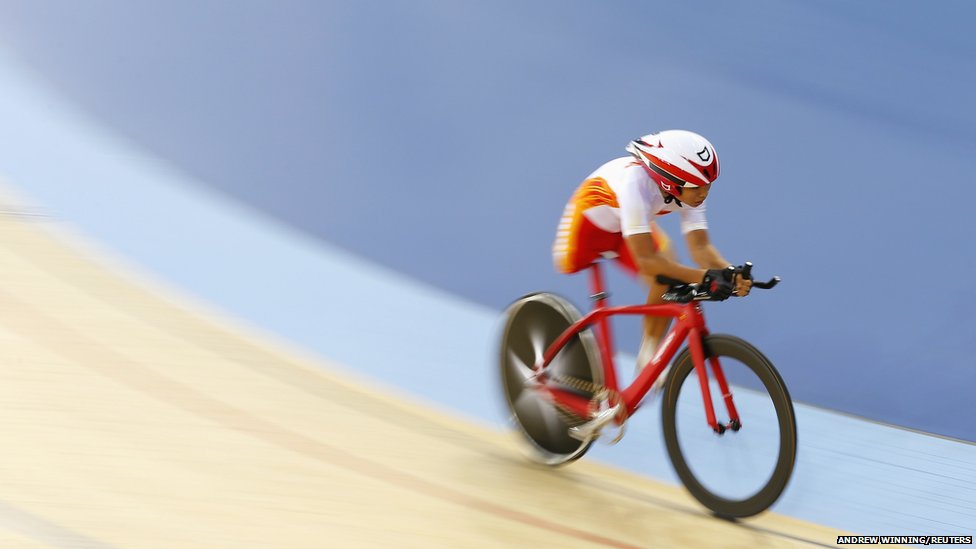
Ex-RAF serviceman Jon-Allan Butterworth competing at the velodrome Paralympic cyclist Jon-Allan Butterworth is a former RAF serviceman

People needlessly go red and start apologising if they say the word "walk" in front of a wheelchair user on your average day in Britain. And this all occurred shortly before GB's man David Weir won the 5000m in such an impressive style that his name started trending round the world on Twitter and he was "mentioned" by Olympic runner Usain Bolt.

If disabled people previously only found common ground on negative things - like hating being called special - perhaps these widely covered, jaw-dropping Games will present some collective positives to latch on to.

PET+BLOGSPOT is the ONLINE BLOG of the Malaysian Animal-Assisted Therapy for the Disabled and Elderly Association or Petpositive. Our stories are CURRENT, ACCURATE and RELIABLE. We offer both local and foreign news on animals, disability and the elderly. PET+BLOGSPOT was first established in October 2007. Our hits since then are now 150,000 and ever increasing! PET+BLOGSPOT is updated daily. Kindly note that views expressed in PET+BLOGSPOT are not necessarily those of PETPOSITIVE. You may also visit our Webpage by browsing: www.petpositive.com.my You can also find us in Facebook under PETPOSITIVE EMPOWERMENT. Please sign up as a FOLLOWER of this Blog if you haven't done so already in order to show us your kind support for our work. Thank you!

Monday, September 03, 2012

Paralympics Warms UK Hearts

Paralympics taken to UK's heart, Locog says

Wheelchair athlete David Weir of Great Britain Record TV audiences have been tuning in to watch stars such as wheelchair athlete David Weir
 
The UK has taken the Paralympics "to its heart", organisers have said, with the Games set to see the one-millionth visitor over the next 48 hours.
Locog said the 10,000 extra tickets being put on sale every day were being bought within minutes.
Record TV audiences have also prompted Games broadcaster Channel 4 to clear its daytime schedule for more coverage.

ParalympicsGB now sit second in the medal table behind China after winning 16 golds, seven of them on Sunday.

Across the day Great Britain won seven golds, eight silvers and three bronze medals in events including cycling, rowing, dressage, swimming and athletics.

Elsewhere there was controversy as South African favourite Oscar Pistorius, who also competed in the Olympics, took silver in the T44 200m final behind surprise winner Alan Oliveira, of Brazil.
Afterwards Pistorius complained that his rival's blades were too long, but officials insisted no rules had been broken.

ParalympicsGB are now well over halfway to their target of 103 medals after just four days of competition.
 
Their medal tally stands at 16 gold, 24 silver and 14 bronze. China have 35 golds, with Australia and Ukraine the next best nations with 13 each.
Almost three million television viewers watched 17-year-old swimmer Ellie Simmonds break the world record as she won gold in a dramatic S6 400m freestyle race on Saturday.

Jay Hunt, chief creative officer at Channel 4, said: "The coverage of the Paralympics has completely captured the public's imagination. We are clearing our schedule to bring viewers even more of this fantastic sport."

The UK broadcaster had been showing late afternoon coverage on sister station More4 but will make the change from Monday after strong viewing figures, include peak audiences of 11.2 million viewers for last week's opening ceremony.

The channel will show daily Games coverage from 07:00 BST to 23:15 BST, with a 30-minute break for Channel 4 News at 19:00 BST.

A Locog spokesman said: "The whole of the UK has taken the Games to its heart. As soon as tickets have been released, they have been snapped up."
Also at the Games on Sunday:
On Monday, highlights for Britain include Pearson in the individual freestyle test, Simmonds back in the pool in the 200m, David Weir on the track in the 1500m and John Stubbs defending his archery title.

Meanwhile, the International Paralympic Committee (IPC) has defended its decision not to drug test all medal-winning athletes, in contrast to what happened at the London Olympics.

The IPC said the greater number of events made that "impossible", with more than 500 golds being competed for compared with 300 at the Olympics.

It said more than a quarter of the 4,200 Paralympic athletes competing in London would be tested - up a fifth on Beijing 2008.

More on This Story

Related Stories

The BBC is not responsible for the content of external Internet sites

PET+BLOGSPOT is the ONLINE BLOG of the Malaysian Animal-Assisted Therapy for the Disabled and Elderly Association or Petpositive. Our stories are CURRENT, ACCURATE and RELIABLE. We offer both local and foreign news on animals, disability and the elderly. PET+BLOGSPOT was first established in October 2007. Our hits since then are now 150,000 and ever increasing! PET+BLOGSPOT is updated daily. Kindly note that views expressed in PET+BLOGSPOT are not necessarily those of PETPOSITIVE. You may also visit our Webpage by browsing: www.petpositive.com.my You can also find us in Facebook under PETPOSITIVE EMPOWERMENT. Please sign up as a FOLLOWER of this Blog if you haven't done so already in order to show us your kind support for our work. Thank you!